
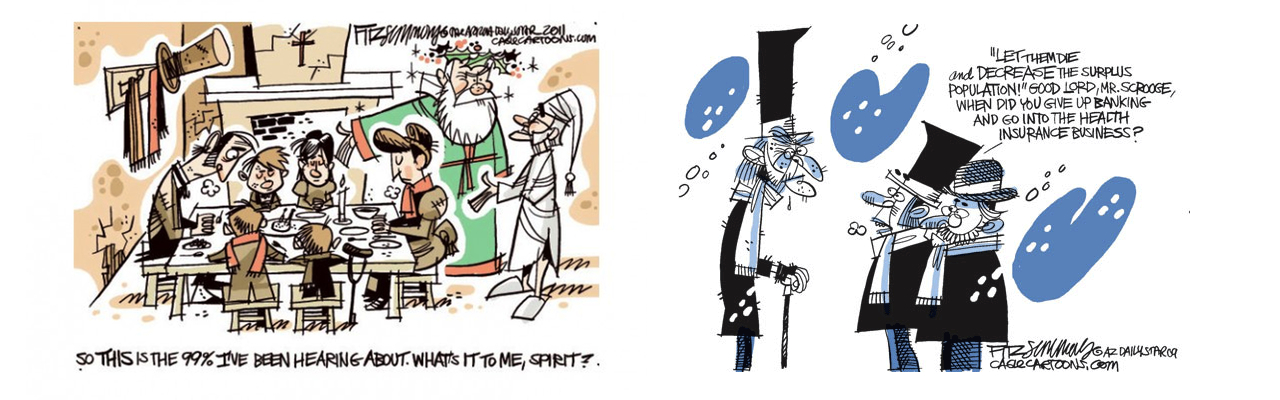
to my loyal band of followers – and trusting that you are all the later model, post-ghosts versions of Scrooge this Christmas! (NB – you may need to zoom in to read the captions.)
to my loyal band of followers – and trusting that you are all the later model, post-ghosts versions of Scrooge this Christmas! (NB – you may need to zoom in to read the captions.)
Just finished listening to Angus Deaton’s lecture at the LSE in October – see the link below. He was introducing his book about the “great escape” from poverty and ill health, and touching briefly on his controversial views on foreign aid (he doesn’t favour it). But listen to the end for his advice – as in the title – as to what his Princeton students should do about world poverty. The other great theme: don’t think in silos – people’s welfare involves politics and health as much as economics. Enjoy: http://goo.gl/IXHWrl

I am indebted to the Financial Times, today’s edition, bottom of p5 , for alerting me to George Osborne’s plans for tax breaks for “social capital” – see p 87 of the Autumn Statement, which you can download here – http://goo.gl/vGQ3WU
This seems to mean equity or loan investments will qualify for relief at the investor’s marginal tax rate, as already happens for Venture Capital Trusts (see, for example, this from Citywire – http://goo.gl/JcynaC). As we are promised a “road plan” for this in January, we should know more then. Here is the relevant paragraph in the AS:
2.51 Social investment tax relief – The government will introduce a new tax relief for equity and certain debt investments in social enterprises with effect from April 2014. Organisations which are charities, community interest companies or community benefit societies will be eligible. Following consultation, investment in social impact bonds issued by companies limited by shares will also be eligible. The government will publish a roadmap for social investment in January 2014. (Finance Bill 2014) .
No doubt many of you will have read the hilarious story of Brett King & his tussle with HSBC USA over their closing his business banking account (see http://goo.gl/hpnHu7). Only hilarious, mind, if you are not Brett King, one of his employees, or a shareholder in HSBC.
It’s really a mind-boggling list of sins:
Now – confession time. Several years ago, I actually moved my accounts to HSBC – from Barclays, as they were (at the time) even worse. And as a customer I would actually rate HSBC pretty highly – especially on internet banking, where their Global View facility works very well. But then, I’m not Brett King, who doubtless has other thoughts.
And who will no doubt be using this case to strengthen his argument for Movenbank (see https://movenbank.com).

Tea at the House of Commons was quite a treat (after you got through the 45 minute security): cream scones & champers at 4 o’clock seems a pleasant way to encourage democratic participation.
And the raison d’être? – Chi Unwurah, Labour’s Shadow on the Big Society, was sponsoring a Ford Foundation session on Financial Governance for Innovation & Social Inclusion (#fgisi), very ably chaired by Mariana Mazzucato.
The speakers were a motley crew. They have an entirely legitimate concern about value extraction rather than value creation by parts of the financial sector (i.e. theft to the man in the street) and a focus on the role the state can play in fostering innovation (lots of good examples from US and elsewhere). Their main link seems to be Ford Foundation funding – while there was a call for a co-ordinated policy response to the issues they were raising it’s difficult to see how this would work in practice.
It’s often the one-liners I take away from these events. This time, I thought the best one was from Ngaire Woods. “Beware the dazzling goose” she said – referring to the financial sector, and its ability to dazzle politicians with its complexity and promise of taxable capacity. She (and others) also had some good suggestions as to what sunglasses to wear: try seeing it collectively with others (e.g. the EU, now even the Swiss) who are less dazzled. And keep the rules to regulate it simple.

Ever wondered how long it would take you to start a new business in Suriname? 208 days apparently – at least, according to the World Bank report shown above. Worth a look – plus the blog commentary on it at goo.gl/id23Yl
The deal on the financing of the new nuclear facilities at Hinkley Point has some interesting features. If EdF can manage the construction risk ( a big if, given the sagas at two other plants) they should earn a healthy (long term) rate of return, given the guaranteed, index-linked price offered for the electricity.
Unfortunately there are no obvious ways in which long term UK investors can take a punt on this. They could presumably buy the new bonds issued by China General Nuclear Power, priced at a mere 2.4% over treasuries, but they are only for five years and are dollar-denominated ( see http://goo.gl/DRPFnO).
The government could, of course, have structured the deal differently, and commissioned EdF to do the build while financing some of the costs by issuing its own sterling nuclear bonds – either on a conventional basis (as with China General) or as a kind of Social Impact Bond (see http://en.wikipedia.org/wiki/Social_impact_bond). The SIB could pay a coupon when the plant comes on stream, and link the coupon to the guaranteed electricity price. If the place suffers a Fukushima-style disaster both capital & coupon on the SIB would be lost.
So far SIBs have been limited to non-energy programmes, but given the scale of the investment required there must be a case for looking at them here. For pension funds, they could be attractive, as they are a deferred, index linked asset to match their deferred, index-linked liability. And given the carbon benefits, even Prince Charles might be happy (last week, he was lecturing pension fund managers on the need for longer term, sustainable investments – hence the picture above). Come to think of it, perhaps he’s got room for some nuclear at Highgrove??.
The Thatcher government was bold enough to start index-linked bonds. It’s time for the coalition to step up to the mark and allow investors and taxpayers some upside on nuclear energy investment.
Prince Charles’ address to the National Association of Pension Funds (see http://youtu.be/SXRwPzj6vxk) is worth a look – yes, it surprised me too, but he actually has some quite insightful things to say about long term sustainability.
Some complaints in the press (and among the academics, who should know better) about both Eugene Fama and Robert Schiller (plus the third man, Lars Peter Hansen) jointly winning the Nobel Prize for Economics.
Personally, I think it’s a great example – a theory (the efficient markets hypothesis) is developed, and leads to practical implementation in areas such as the development of indexed funds. Then another academic comes along (Schiller) pointing out the limitations of the theory. All three place a heavy emphasis on empirical validation – Fama from publishing his data, Schiller from creating the Case-Schiller House Price index for the US, and Hansen (OK, I hadn’t heard of him either) for valuable work in econometrics (see http://goo.gl/5PDxYW). Isn’t that what Kuhn’s theory of scientific revolutions is supposed to be all about?
A quick addendum to my blog below on Africa post 2015 – catching up on my LSE Alumni collections, I see that Mariana Mazzucato was speaking recently on the role of the state – advocating a role beyond market fixing to market creation. You can get a quick 17 minute overview (if, like me, you missed the lecture itself) on Youtube – here’s a Tweet link:
TEDxSussexUniversity – Mariana Mazzucato – The Entrepreneurial State: http://t.co/FpBJ4iUIZs via @youtube
— paolo bonaretti (@paolobonaretti) October 9, 2013
plus you can also follow the good lady on Twitter itself.

