
Real returns and market timing

20 Feb

No rest wicked“No rest for the wicked”, as my (Catholic) grandfather used to say – or as the latest evidence from the famous LBS stable of Elroy Dimson, Paul Marsh & Mike Staunton shows, no rest for those trying to earn a “decent” (5% real?) return from their savings. They foresee a world of virtually zero real rates on “safe” bonds and an equity risk premium of 3 to 3.5% on a “long” (20-30 year) view. This is all set out with impressive academic rigour in the excellent (and free, as far as I can see) Credit Suisse Global Investment Returns Yearbook for 2013 (http://goo.gl/CHmU7).

They also pretty effectively dish “market timing” strategies in favour of buy and hold – for those of you with access to the FT, there is an excellent video of an interview with Elroy by John Authers which is also a must see.

The only saving grace I can see in this is that we should, on this basis, expect a boom in capital investment, especially in long-lived capital investment projects, which should now require lower real returns. So now should be the time for new water ring mains, Crossrail Mark 2, third London Airport et al. The trouble is, I cannot see our crotchety Coalition government and rather antique planning laws delivering on this in the foreseeable future.
Banking reform – Southwold shows the way!

19 Feb

Whack a banker v2

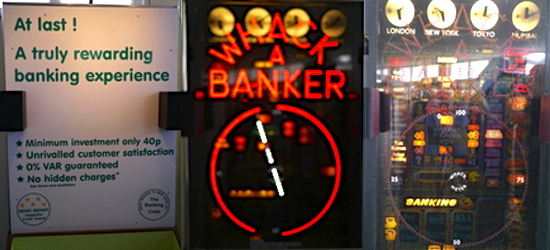
I see the FT on Monday morning was announcing that Britain had been “outgunned” on EU bank curbs – a proposal from the European Parliament to limit bankers’ bonuses to twice base salaries looked likely to go through. However, a visit to Southwold Pier on the east coast of England at the weekend showed an alternative approach to the banking crisis – one that so far seems to have escaped the notice of the Basel Committee, the EU, the Obama administration, and the Financial Stability Board.

The picture gives a clue – it’s simply a “whack the banker” pier game, where, putting your 40p in the slot, you get the pleasure of whacking bankers for 60 seconds, with an accompanying audio commentary about your role as a taxpayer in funding their pensions and bonuses.

Of course, this may be dangerous territory for Southwold, as one suspects that some of the mouth-watering property prices in the vicinity may owe just a tad to – yes, you’ve guessed it, bank bonuses!

Obama & Stiglitz on inequality and the power of the state

11 Feb

I first saw clips of Obama’s second inaugural speech (see http://goo.gl/S62Wi) on newsroom reports – and was so encouraged by the clips that I thought I should listen to the whole twenty minutes. It doesn’t disappoint.

In parallel with this I’ve been reading Stiglitz’ book on Inequality. He documents clearly the rising levels of inequality in income & wealth in the US since the Reagan years. While not all of this increase has been driven by policy (globalisation has played a major part), there is no doubt that the favourable treatment of non-labour income is a a major culprit.

How do these inequalities stand up against the Declaration of Independence’ “self evident” truth that all men are created equal?  Obama is clear: “..while these truths may be self-evident, they have never been self-executing; .. the patriots of 1776 did not fight to replace the tyranny of a king with the privileges of a few or the rule of a mob. They gave to us a Republic, a government of, and by, and for the people, entrusting each generation to keep safe our founding creed.”

He goes on “ But we have always understood that when times change, so must we; that fidelity to our founding principles requires new responses to new challenges; that preserving our individual freedoms ultimately requires collective action.”

The collective action he envisages turns on using the power of the state to provide (cost effective) safety nets, education and opportunity – “we must harness new ideas and technology to remake our government, revamp our tax code, reform our schools, and empower our citizens with the skills they need to work harder, learn more, and reach higher”.

And it isn’t all “socialism” – there are references to initiative and enterprise, hard work and personal responsibility, and America’s prosperity “resting upon the broad shoulders of a rising middle class”.

Stiglitz may have done the analysis – but it will take all of Obama’s campaigning skills to do something about it.

So if the stock market Santa is late, does the efficient markets hypothesis still apply?

21 Jan

Santa Efficient Markets

So there I was, working away in H M Treasury in the last Great Recession (1980-84 from memory), when one of my colleagues piped up – “so I suppose evidence of seasonality in stock market prices would be prima facie evidence against them being efficient?”

It was a rhetorical question, as the answer was obviously yes – if stock prices exhibited seasonality, say rising in the spring and falling in winter, you could trade to beat the market. So markets were not, in some sense, “efficient” – they did not price in all of the available information (in this case, the seasons). And if you had information they did not appear to have (in this case, whether it was spring or winter) you could do what Margaret Thatcher advised you could never do – buck the market.

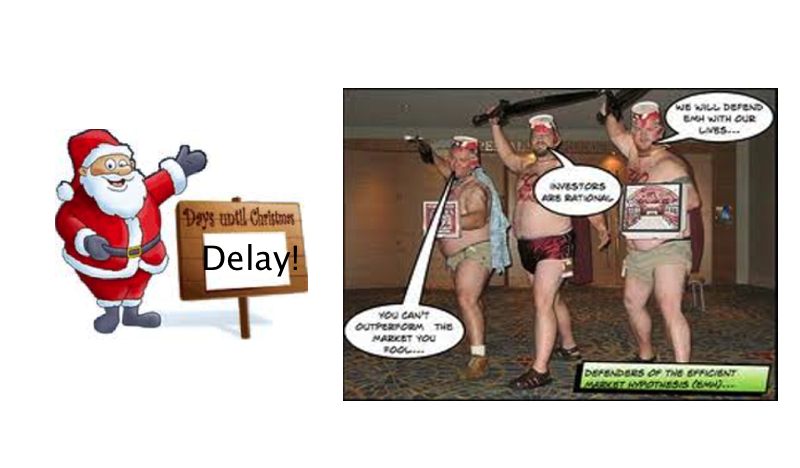
“Oh come on”, I can hear you say, “can’t you find a better and less trivial example?” Well, how about this? As David Schwartz pointed out in an FT article on 30th November, in 19 of the previous 21 years since 1989, the stock market had risen in December. 2012 proved no exception, with a rise in the FT 100 (and FT All Share) – but by only 0.5%. However, the end of December was mired by worries about the US fiscal cliff, so had you hung on till the markets opened on the second of January, you would have done much better – a gain of over 2.5%. Hence the argument about Santa being delayed.

Evidence that perhaps markets are not as efficient as all that also comes from a more academic source, where Pontiff & McLean have published a paper on whether published academic research destroys stock return predictability – a paper also picked up by the FT. “Not completely” appears to be the short answer, although publication of a “profitable” trading strategy (ie buy before December) does then reduce the returns you can expect significantly – especially for large, easy to trade stocks.

Bit of a mystery, though, we still see the Santa effect in stock markets – after all, it must now count as a published strategy. Transactions costs? End of year trading constraints? Or are the arbitrageurs too busy at their Christmas parties?

West Coast Mainline – so who was driving the train?

18 Dec

According to Sam Laidlaw, appointed by ministers to look at why the franchise for the West Coast Mainline was such a £40m cock-up, the answer is – nobody really (see http://goo.gl/eg8pS for a report of his appearance before the Transport Select Committee). Certainly not ministers, who asked “penetrating questions”. And not the senior civil servants of whom these “penetrating questions” were asked, since they “had no reason to suppose the process was flawed as the lower levels were not escalating the problems to them”.

This is a tad unfair, as both Laidlaw’s Interim and Final reports ( see http://goo.gl/yWi8G) do a pretty clinal job in analysing what went wrong – the main culprits being a complex and poorly understood economic & financial model, and a management structure within the Department that simply did not work (post various reorganisations and cuts). Of course, given the “Francis Maude” view that Britain’s most senior civil servants deliberately block Government policies they do not agree with, one can understand if the DoT senior officials were reluctant to stand up & say that the changed franchise policy was an accident waiting to happen.

But if ministers have put into effect “in a rush” train crasha policy (longer rail franchises) without ensuring they have the resources to implement it properly, don’t they bear some responsibility?

Ronald Coase writes in Harvard Business Review on economics and business

22 Nov

A surprise was in store when I (digitally) opened the latest HBR – a contribution from Ronald Coase on “Saving Economics from the Economists”. A surprise because I had assumed that the author of the seminal 1937 paper on “the Nature of the Firm” was no longer with us (Wikipedia tells me he’s in fact going strong at 101). Nice to see his article returns to this subject, with a plea that economics has strayed too far into theory to be useful to “business”. Although I’m not sure the article’s main thesis is right. I seem to recall that the latest Nobel prize in economics went to to professors Alvin Roth and Lloyd Shapley for their work on the best possible way to allocate non-priced resources (for example, scarce places in popular schools). That seems pretty practical to me. And of course, whilst economics may have become more rigorous, the whole field of business school education and research has opened up in ways that (I would assume) a younger Ronald Coase could not possibly have imagined.

To be sure, much of the business school writing lacks definitive guidance for businessmen – but isn’t that just a reflection of what I vaguely recall as “the oligopoly problem” – the appropriate model for many markets today?

But whatever the gripes it’s worth a read.

Personal banking: before we get onto mobile & social media, can we just fix the basics?

5 Nov

As I am at present “resting” between assignments, I have had the chance to sort out some of our personal financial affairs. This has led me to dealings with banks & building societies other than HSBC, to whom I switched my main banking relationship 4/5 years ago.

For example, I have had dealings recently with “a major UK building society”. They are currently advertising on TV that, while you do need a bank account, you don’t need a bank. True enough, but there are certain basics you have to get right. In my case, I need to transfer my online account to joint names – so I take a form into a branch (well, OK) and then check a week later online to see if it is, indeed, in joint names. Problem: the internet banking site doesn’t show me if it’s single or joint names – indeed, it shows no name at all. Not a good start given that I want to transfer funds to an e-savings product with them. However – it gets worse. I phone the contact centre. They want to “take me through security.” Only problem – their questions were different from those used to set up internet banking, and ones I didn’t know the answers to (e.g.”what is the overdraft limit on your account” – “don’t know, I never use it”). So I failed security clearance, which always makes me mad. Can it get worse? – yes it can! OK, I said – get someone to phone me back. “Oh I’m sorry sir, we can’t do that, we are an inbound call centre only”. Time to start chewing the carpet. In fact I emailed my query in & they answered – but in the process they had gone down the snake to the bottom of the pyramid (see the graphic below from an IBM White Paper on rebuilding customer trust in retail banking – http://goo.gl/Kvm7B)

The trust pyramid in retail banking – see the IBM White Paper

Contrast HSBC. “Would you like to talk to one of our Premier advisers?” Well, I suppose I ought. Fill in the form, 90 minute slot booked (yawn) – but in fact a sensible 20 minute conversation with one or two good ideas. And they had helpfully suggested I do it before, following the Retail Distribution Review, they introduce charging (a topic which will need another blog entry). So they secure a place at the top of the graphic  – acting in my best interests even with no immediate benefit.

The problem with retail banking is that it generates too many customer experiences that push people down the snakes to the bottom of the pyramid, and not enough that provide a ladder to the top. The good are very good – and are ready to go mobile, exploit social networking etc. But the rest better fix the basics!

A Volcker rule for the UK?

30 Oct

Disagreements over bank ring fencing

It appears that not everybody is happy with the Vickers proposals to ring fence retail banking operations from the “casino” operations of investment banking. Paul Volcker criticised the approach to the UK Banking Standards Committee, and last night John Kay weighed in with his views, commenting, according to the FT, that “it would be very difficult to do this”. Not surprisingly, Volcker prefers his own per se ban on proprietary trading, while John Kay’s own views on (very narrow) banking have already been published.

In the (unlikely) event that the UK were to switch from ringfencing to a Volcker rule, we would be aligning ourselves with the US approach rather than the Europeans, who, under the Liikanen proposals, look to be going down a ringfence route. Banks trading in both US and the EU are clearly going to have a fun time.

No time for the Brett King Bank 3.0 book? Well, try the images I’ve pinned..

28 Oct

In the last couple of days I’ve come across two good graphics on the growing ubiquity of mobile – even in a pre-4G world. Pinned to a new board on Pinterest – see the link on the right hand side.

Something for the weekend – Brett King’s Bank 3.0 is here – see my first thoughts

26 Oct

My copy arrived, courtesy of Amazon during the week. On first look, it maintains the high quality of the original, and is a more detailed think piece than his “Branch Today, Gone Tomorrow” polemic. Of course, in the couple of years since Bank 2.0 was published (May 2010), his ideas have become more mainstream, and social media/mobile/digital relationships can no longer be ignored. The investment required is less the cash (£13.99 on Amazon) than the time to properly read & think through his analysis. Let’s hope Sir David Walker has bought a stack & is giving them out to his new Barclays board nominees.