Innovation. the Big Society, and the “dazzling goose”: tea at the House of Commons

26 Nov

Screen Shot 2013-11-25 at 21.16.54

Tea at the House of Commons was quite a treat (after you got through the 45 minute security): cream scones & champers at 4 o’clock seems a pleasant way to encourage democratic participation.

And the raison d’être? – Chi Unwurah, Labour’s Shadow on the Big Society, was sponsoring a Ford Foundation session on Financial Governance for Innovation & Social Inclusion (#fgisi), very ably chaired by Mariana Mazzucato.

The speakers were a motley crew. They have an entirely legitimate concern about value extraction rather than value creation by parts of the financial sector (i.e. theft to the man in the street) and a focus on the role the state can play in fostering innovation (lots of good examples from US and elsewhere). Their main link seems to be Ford Foundation funding – while there was a call for a co-ordinated policy response to the issues they were raising it’s difficult to see how this would work in practice.

It’s often the one-liners I take away from these events. This time, I thought the best one was from Ngaire Woods. “Beware the dazzling goose” she said – referring to the financial sector, and its ability to dazzle politicians with its complexity and promise of taxable capacity. She (and others) also had some good suggestions as to what sunglasses to wear: try seeing it collectively with others (e.g. the EU, now even the Swiss) who are less dazzled. And keep the rules to regulate it simple.

Some data for the globe-trotting social entrepreneur

11 Nov

Doing Business 2014

Ever wondered how long it would take you to start a new business in Suriname? 208 days apparently – at least, according to the World Bank report shown above. Worth a look – plus the blog commentary on it at goo.gl/id23Yl


Nuclear bonds are what we need

23 Oct

Nuclear

The deal on the financing of the new nuclear facilities at Hinkley Point has some interesting features. If EdF can manage the construction risk ( a big if, given the sagas at two other plants) they should earn a healthy (long term) rate of return, given the guaranteed, index-linked price offered for the electricity.

Unfortunately there are no obvious ways in which long term UK investors can take a punt on this. They could presumably buy the new bonds issued by China General Nuclear Power, priced at a mere 2.4% over treasuries, but they are only for five years and are dollar-denominated ( see http://goo.gl/DRPFnO).

The government could, of course, have structured the deal differently, and commissioned EdF to do the build while financing some of the costs by issuing its own sterling nuclear bonds – either on a conventional basis (as with China General) or as a kind of Social Impact Bond (see http://en.wikipedia.org/wiki/Social_impact_bond). The SIB could pay a coupon when the plant comes on stream, and link the coupon to the guaranteed electricity price.  If the place suffers a Fukushima-style disaster both capital & coupon on the SIB would be lost.

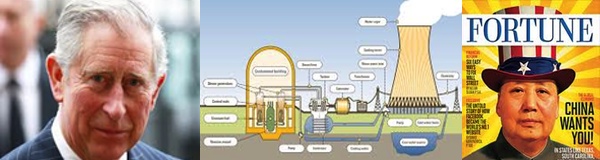
So far SIBs have been limited to non-energy programmes, but given the scale of the investment required there must be a case for looking at them here. For pension funds, they could be attractive, as they are a deferred, index linked asset to match their deferred, index-linked liability. And given the carbon benefits, even Prince Charles might be happy (last week, he was lecturing pension fund managers on the need for longer term, sustainable investments – hence the picture above). Come to think of it, perhaps he’s got room for some nuclear at Highgrove??.

The Thatcher government was bold enough to start index-linked bonds. It’s time for the coalition to step up to the mark and allow investors and taxpayers some upside on nuclear energy investment.

Prince Charles and sustainability

22 Oct

Prince Charles’ address to the National Association of Pension Funds  (see http://youtu.be/SXRwPzj6vxk) is worth a look – yes, it surprised me too, but he actually has some quite insightful things to say about long term sustainability.

Nobel Prize time in Economics – Fama & Schiller are consistent enough

15 Oct

Some complaints in the press (and among the academics, who should know better) about both Eugene Fama and Robert Schiller (plus the third man, Lars Peter Hansen) jointly winning the Nobel Prize for Economics.

Personally, I think it’s a great example – a theory (the efficient markets hypothesis) is developed, and leads to practical implementation in areas such as the development of indexed funds. Then another academic comes along (Schiller) pointing out the limitations of the theory. All three place a heavy emphasis on empirical validation – Fama from publishing his data, Schiller from creating the Case-Schiller House Price index for the US, and Hansen (OK, I hadn’t heard of him either) for valuable work in econometrics (see http://goo.gl/5PDxYW). Isn’t that what Kuhn’s theory of scientific revolutions is supposed to be all about?


Two hands not one: the role of the state

9 Oct

A quick addendum to my blog below on Africa post 2015  – catching up on my LSE Alumni collections, I see that Mariana Mazzucato was speaking recently on the role of the state – advocating a role beyond market fixing to market creation. You can get a quick 17 minute overview (if, like me, you missed the lecture itself) on Youtube – here’s a Tweet link:

plus you can also follow the good lady on Twitter itself.

Post 2015 Africa: central planning or the market?

3 Oct

Diageo Ethiopia

Attended an excellent event last week at Standard Chartered in the City, sponsored by Business Fights Poverty (http://businessfightspoverty.org). It was a panel discussion on a new report – “A New Global Partnership with Business – Building a post-2015 development framework to achieve sustainable prosperity in Africa”. Despite the mouthful of a title (and the title slide for the presentation had no less than eight corporate sponsors – four at the top, four at the bottom), the report is actually a good read (download from here: http://goo.gl/SG8FOT).

The panel discussion was equally good. By the time it had finished, I was feeling quite sorry for Diageo, very ably represented by Ann McCormick. They are one of the case studies in the report, focusing on their acquisition of Meta Abo Brewery in Ethiopia and their efforts to source more malt & barley locally. Their partnership efforts were certainly impressive, spanning the top (a G8 pledge signed with Obama & Hilary Clinton watching), the Ethiopian government (via their Agricultural Transformation Agency) and local implementation via an NGO working with smallholder farmers (Farm Africa). But what struck me in discussion was Ann McCormick’s obvious concern as to what the newly enriched smallholders were actually doing with their extra cash.

Hardly a problem, one would think, when Diageo buys grain in the developed world, but probably a real enough issue in Ethiopia. And just one small example of the hurdles businesses have to jump through to be good corporate citizens in Africa.

So why the title? I recall a lecturer in Cambridge saying once: “When I visit Russia [this was the 1970s] I think – My God, how they would benefit from some market mechanisms. Then when I visit the States, I think: My God, a bit of central planning wouldn’t hurt.” At the time, I was too inexperienced to value the remark, but with the passage of time I see its truth. The market can’t solve everything in Africa (or elsewhere) – it needs other institutions, including government, to play their part. One invisible hand is all very well, but two hands are better.

Time for a change – more focus on social entrepreneurship

24 Sep

The observant among you will have noticed that I’ve changed the strapline on this blog to reflect my current interests – namely “social entrepreneurship” (of which more below), financial services, and public policy.

It’s an eclectic mix – but its foundation is my training as an economist, and how I’ve spent my time since graduating in 1975 – firstly, 10 years as an economist in government (including 5 years at H M Treasury in the early 1980s), and then 25 odd years in management consulting, focusing first on public policy questions and then for the last 15 years on financial services.

Social entrepreneurship is new. Over the last year or so since leaving IBM I have become increasingly interested in the role business (including small business) can play in helping to solve social problems, both in the UK and overseas, and have started to network more widely (my first meeting with Business Fights Poverty –  http://businessfightspoverty.org – is tomorrow). To my mind, this is an idea whose time has come – I was delighted to see that Esther Duflo (co-author with Abhijit Banerjee of Poor Economics) was this year’s Marshall Lecturer at Cambridge, and Georgia Keohane’s book and lecture, at the LSE, on Social Entrepreneurship for the 21st Century was also inspiring. Like Keynes, I think it is ideas, not vested interests, which are dangerous for good or evil – in this case, very much for good.

There are of course important links between these themes. Social entrepreneurship, as Keohane shows, is highly dependent on the public policy framework, and finance and investment play a major role in economic development. Of course, sometimes it is tempting just to abandon an avenue – looking at the latest financial mis-selling scandals, you feel the industry is like the Bourbons “they have learnt nothing and forgotten nothing”.  But I still find things I want to say.

So I hope you will like this eclectic mix – and I would welcome your feedback!

Go back

Your message has been sent

Warning
Warning
Warning
Warning

Warning.

Should governments stabilise the stock market?

22 Jul

Well, you probably think the silly season has set in with a vengeance when you read that. But in an article in the FT on Thursday, and in testimony to the Treasury Select Committee in April, that is what Professor Roger Farmer from Colombia recommends. Since, as Keynes reminds us, “madmen in authority, who hear voices in the air, are distilling their frenzy from some academic scribbler of a few years back”, perhaps Professor Farmer’s idea should be investigated.

He bases his recommendation on “The Inefficient  [Financial] Markets Hypothesis”, the title of an NBER Working Paper authored by Farmer and his colleagues Nourri and Venditti (you can buy for $5 from http://www.nber.org/papers/w18647, or just read the abstract).  This shows that, when you introduce “real life” assumptions like population change and differing discount rates among individual investors, however rational individual investors may be, markets are not rational, or, in the jargon, Pareto efficient. Hence the possibility that government intervention could make some investors better off without necessarily making others worse off.

Now, it has to be said that a financial economist proving that stock markets are not rational or efficient may not come as a great surprise to investors, those in the financial services industry, or even the man on the Clapham Omnibus. Let’s take just one recent example: Bernanke says Quantitative Easing (QE) will wind down as the US recovers – and global markets drop like a stone. Carney, in the UK, says QE will be replaced by more market guidance – surely a stronger move, as it’s unconditional – and the UK stock market goes up 1%. Rhyme or reason ?- difficult to see.

But back to the issue in hand – could governments set up some kind of sovereign wealth fund to “lean into the wind”, buy stocks when they are “unrealistically low” and sell them when they are “unrealistically high”? I rather doubt. To move markets, the fund would have to be “big”, probably “very big” – and with a known strategy, hedge funds and everyone else could trade against it. While Farmer gives the example of the success of central bank inflation targeting, a better example (and a more humbling one) would be central banks’ efforts to defend fixed exchange rate parities – frequently unsuccessful, and frequently very costly, because they give other market traders the famous “one-way bet” – the exchange rate may fall [if intervention doesn’t work] but it certainly won’t rise. And there are a multitude of governance issues – when to intervene, how to recruit quality staff, etc.

But even if  a sovereign wealth fund poses difficulties, Farmer’s work raises another question – why aren’t there more “contrarian investors” who see through the inefficiency of markets and trade profitably as a result. Of course, there are some – I recall a colleague proudly announcing, as bank shares collapsed in 2008, that he’d bought a few and that should see his kids through university. I’m sure at current valuations his plan is on track. But more generally, there do not seem to be “enough” funds with “the long view” willing to make these kinds of bets. Our market structures do not help – annual performance reviews against benchmarks for investment mandates, and the decline of with profits funds for example, pressure many fund managers to not step out of line. So perhaps an investigation as to why we don’t have more contrarian investors, and whether rules and regulations could be tweaked to encourage them, might be a better (if less sexy) outcome to the work of Farmer and his colleagues than governments setting up sovereign wealth funds.

End of Competitive Advantage by Rita Gunter McGrath is worth a look

24 Jun

endcompadv

So fresh from a webinar on this from the good lady herself – very impressive. And the HBR article (June edition) is also worth a read. She’s succeeded in (what I imagine to be) a key objective from the webinar – I’m going to buy her book. Also signed up to her newsletter, which promises me access to the mystic arts (viz, I get a password to the tools section on her website, and I’m a great collector of tools).

Two points struck me. The first is that her model of the new career paradigm (build networks, manage your own career, don’t expect a job with one firm for life) sounds a lot like management consultancy to me. Second, she clearly despairs of the non-profit sector – too much fragmentation, not enough competitive pressure. To which I would add – often, very limited management ability.

There are clearly debts her to the resource-based view of the firm and the exploitation of “core competencies”. So one assumes that Gary Hamel is an admirer – or perhaps, dare one say it, a competitor, who is worried that Rita will undermine his competitive advantage?