Should governments stabilise the stock market?

22 Jul

Well, you probably think the silly season has set in with a vengeance when you read that. But in an article in the FT on Thursday, and in testimony to the Treasury Select Committee in April, that is what Professor Roger Farmer from Colombia recommends. Since, as Keynes reminds us, “madmen in authority, who hear voices in the air, are distilling their frenzy from some academic scribbler of a few years back”, perhaps Professor Farmer’s idea should be investigated.

He bases his recommendation on “The Inefficient  [Financial] Markets Hypothesis”, the title of an NBER Working Paper authored by Farmer and his colleagues Nourri and Venditti (you can buy for $5 from http://www.nber.org/papers/w18647, or just read the abstract).  This shows that, when you introduce “real life” assumptions like population change and differing discount rates among individual investors, however rational individual investors may be, markets are not rational, or, in the jargon, Pareto efficient. Hence the possibility that government intervention could make some investors better off without necessarily making others worse off.

Now, it has to be said that a financial economist proving that stock markets are not rational or efficient may not come as a great surprise to investors, those in the financial services industry, or even the man on the Clapham Omnibus. Let’s take just one recent example: Bernanke says Quantitative Easing (QE) will wind down as the US recovers – and global markets drop like a stone. Carney, in the UK, says QE will be replaced by more market guidance – surely a stronger move, as it’s unconditional – and the UK stock market goes up 1%. Rhyme or reason ?- difficult to see.

But back to the issue in hand – could governments set up some kind of sovereign wealth fund to “lean into the wind”, buy stocks when they are “unrealistically low” and sell them when they are “unrealistically high”? I rather doubt. To move markets, the fund would have to be “big”, probably “very big” – and with a known strategy, hedge funds and everyone else could trade against it. While Farmer gives the example of the success of central bank inflation targeting, a better example (and a more humbling one) would be central banks’ efforts to defend fixed exchange rate parities – frequently unsuccessful, and frequently very costly, because they give other market traders the famous “one-way bet” – the exchange rate may fall [if intervention doesn’t work] but it certainly won’t rise. And there are a multitude of governance issues – when to intervene, how to recruit quality staff, etc.

But even if  a sovereign wealth fund poses difficulties, Farmer’s work raises another question – why aren’t there more “contrarian investors” who see through the inefficiency of markets and trade profitably as a result. Of course, there are some – I recall a colleague proudly announcing, as bank shares collapsed in 2008, that he’d bought a few and that should see his kids through university. I’m sure at current valuations his plan is on track. But more generally, there do not seem to be “enough” funds with “the long view” willing to make these kinds of bets. Our market structures do not help – annual performance reviews against benchmarks for investment mandates, and the decline of with profits funds for example, pressure many fund managers to not step out of line. So perhaps an investigation as to why we don’t have more contrarian investors, and whether rules and regulations could be tweaked to encourage them, might be a better (if less sexy) outcome to the work of Farmer and his colleagues than governments setting up sovereign wealth funds.
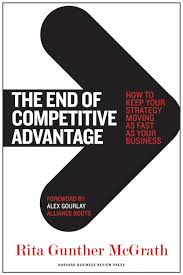

End of Competitive Advantage by Rita Gunter McGrath is worth a look

24 Jun

endcompadv

So fresh from a webinar on this from the good lady herself – very impressive. And the HBR article (June edition) is also worth a read. She’s succeeded in (what I imagine to be) a key objective from the webinar – I’m going to buy her book. Also signed up to her newsletter, which promises me access to the mystic arts (viz, I get a password to the tools section on her website, and I’m a great collector of tools).

Two points struck me. The first is that her model of the new career paradigm (build networks, manage your own career, don’t expect a job with one firm for life) sounds a lot like management consultancy to me. Second, she clearly despairs of the non-profit sector – too much fragmentation, not enough competitive pressure. To which I would add – often, very limited management ability.

There are clearly debts her to the resource-based view of the firm and the exploitation of “core competencies”. So one assumes that Gary Hamel is an admirer – or perhaps, dare one say it, a competitor, who is worried that Rita will undermine his competitive advantage?

Interesting week on “not [just] for profit” front

21 Jun

Social entrepreneurship

So an excuse this week to visit both alma maters – LSE Alumni on Monday evening to hear Georgia Keohane speak about her book (shown above – US-centric but highly recommended) and then, yesterday, a very English event at the Humanitarian Centre, in Cambridge  – strawberries & cream & Sangria with Fenners in the background, on a “rained out” English summer afternoon (my wife, being German, doesn’t believe there is any other kind).

No real content to report from Fenners. But several interesting discussions at the LSE, where Georgia picked out the role of social impact bonds, and their complex interaction with public sector safety nets (i.e. you need public expenditure savings from delivering cheaper public services to fund the bond coupon). Chasing around Twitter/YouTube afterwards, there was also a great clip on what levels of financial returns should be expected from BoP/social impact investing. General view seemed to be at least a “normal” return, but potentially over a longer timescale.

Interesting to think social entrepreneurship could both be more socially useful and more financially rewarding than hedge funds.

The answer to savers’ prayers?

4 Jun

Screenshot_04_06_2013_15_28

So a couple of articles caught my eye in Friday’s FT (31st May – I know this post is a bit late but the weather really has been good!). The first was a prequel to the Banking Commission’s final report – due in June apparently (let’s hope it doesn’t clash with Wimbledon).  This whinged on about the need for a more diverse banking ecosystem (“Rivals sought for Big Five banks” – of course, it would have been the Big Four a few years ago, so perhaps the arrival of Santander means a 20% increase in competition??).

The second article contained the potential solution – it featured the arrival of the new head of PopeBank – or, for the more traditionally minded, the Institute for the Works of Religion (IOR), a Teutonic gentleman by the name of Herr von Freyberg (appointed by the outgoing pope, who helpfully gave him a rosary). No it has to be said that there are a few technical difficulties to be sorted out at PopeBank, but just think of the impact it could have on the UK High Street:

  • guaranteed ethical standards
  • free advertising at every mass
  • cash distribution system already there – just drop another envelope with your account number into the collection
  • plenty of premises for extra ATM machines
  • no need to “bail in” bondholders in the event of difficulties – just ask the faithful to stump up
  • ready-made cadre of financial advisers (viz priests – touch of extra training should do it)

One might even call it a solution made in heaven!

Bank 3.0 – if branches are so yesterday, why are they so full?

25 Apr

So I’m sitting in the sun actually reading Brett King’s Bank 3.0 (rather than just blogging it’s arrived). It’s a good read – I’m on Chapter 3 – Can the branch be saved?- which rather begs the question as to whether you would want to.

I find all the arguments about the need for banking but not for banks very persuasive, and Brett has sourced his evidence well. But perhaps the sunny day helps me to drift off, & I remember a day a couple of years ago when I was in a bank branch (RBS) on a Saturday morning in a market town near us (Chelmsford UK, pop. 100,000).

I was there because there was a cock-up on arranging “floats” for a plant sale I run once a year. There are ten or so stalls, and the turnover on the day is about £2k – about half in cheques and half in cash. There was a new treasurer for the event, and he hadn’t arranged any cash floats for the stallholders, and couldn’t be reached on the phone. So off I went to the nearest market town to see what I could do.

To save you the unbearable suspense, I can tell you that it worked fine. After a rather exasperated counter guy had asked why I hadn’t arranged it in advance, & I had grovelled appropriately, the bags of coins and crisp £5 notes were duly handed over for a wad of cash I had extracted from the ATM. RBS went up several points in my estimation (albeit from a very low base – but that’s a different story).

But the real thing that surprised me was how full the branch was on a sunny Saturday morning of a bank holiday weekend in early May. I knew why I was there – but they couldn’t all be running competing plant sales with similar float cock-ups – could they? It seemed unlikely. Nor were they elderly pensioners unable to cope with new technology – it looked like a pretty representative cross-section of Chelmsford humanity. And it included some digital natives – at least one guy was playing with his i-Phone while standing in the counter queue.

I suppose my experience (admittedly two years ago) may have been atypical, but in my infrequent visits to my own bank branches (HSBC), there still seem to be plenty of people milling about.

So is this irrational behaviour?  Given the stats, the majority of the people I see in branches will have smartphones and/or tablets plus internet access at home & work. However, I’m not sure this makes their behaviour irrational. Like me, they may be dealing with the grubbier end of money transmission – cheques and cash, which, while on the decline, ain’t dying anytime soon. Witness the UK Payments Council’s (wise) decision to back off from announcing the death of the cheque. Or perhaps they were passing & popped in to check something (as I did recently).

Or perhaps they were attracted by the “store makeover” of may retail branches? This is the bit I just don’t believe. Brett has a good section on bank execs trying to remake their stores a la Apple. But if the parallel to a new game on a shiny new retina display is a flexible mortgage or special 1% bonuses on savings (Gosh! – a whole £10 on my £1,000 savings!) I think we can forget it. The trouble with banking is that it’s just too boring.

Brett quotes Chris Skinner’s phrase with approval – less branch banking rather than branchless banking. And how much less will depend on finding cost-effective substitutes for cash and cheques – for SMEs as well as individuals. Or (horror of horrors) a better alignment of prices for money transmission with the true costs.

The other change required is in the mental models bankers use – so they embrace the use of other channels (telephone/Skype/internet/mobile) as a substitute for face to face advice. And, as Brett recommends, realign their budgets so they address the security issues around these channels rather than simply saying they can’t be used.

Salz Review of Barclays – and you thought management consultancy was expensive?

5 Apr

Salz review

There has been some excellent press commentary on this since it was published yesterday. The FT, in particular, has excelled itself – Jonathan Guthrie in Lombard had a spoof sermon from Rev Salz – the visiting preacher at St Barcalys Beyond the Pale ( see http://goo.gl/OBlHF) and Lex has an excellent video (Q from Stuart Kirk, Head of Lex – “Is it simply a statement of the “bleedin’ obvious” – A from Oliver Ralf of Lex – “Yes”; see http://goo.gl/hKJSn for more).

So I will confine myself to two points. One is cost – where the first figure I saw reported was £14.5m, which then rose mysteriously to £17m – presumably the VAT-inclusive price. Now as Anthony Salz’ firm (Rothschild) was “only” paid £1.5m in lieu of his services, that leaves a whole £13m unaccounted for. Comparable consultancy fees from a strategy boutique? Running the slide rule over it, I reckon about £2m should do it. So if I were a shareholder I would be asking some questions – a good starting point might be to get the non-execs over the period covered by Salz to pay for it, since he is basically commenting on their weaknesses.

The second point is not unique to Barclays, and is about changing the rules of the game. As you read through the report, you realise that, over the period from 2005 to 2012, the rules of the game changed – it was as if, coming out after half time, Barclays was faced with an Alice in Wonderland world where the goalposts were smaller and someone had abolished the offside rule. HMRC’s attitude to tax was a good example (see chapter 6). Barclays failed to adapt in time. Businesses need monitoring systems which tell them not only what their competitors are up to but also when the mindset of key stakeholders such as regulators undergo a sea change.

An Easter present for everyone who likes change management

1 Apr

A great set of cartoons for all the actors in the change management drama – plus some useful videos which you can use in your own presentations. And (so far) for free. Enjoy! – here is the weblink  – http://goo.gl/XDWYAChange cartoons

So what is the effect of the Budget on growth? – nil, according to the OBR

20 Mar

Yup, that’s right – nil. Here is the key sentence from the OBR : “The ‘giveaways’ and ‘takeaways’ net to zero when aggregated over the forecast. We have made no significant adjustments to our economic forecast to reflect these measures.” [italics are mine] See para 1.7 of the OBR’s Economic and Fiscal Outlook –  at http://goo.gl/C23eR

Real returns and market timing

20 Feb

No rest wicked“No rest for the wicked”, as my (Catholic) grandfather used to say – or as the latest evidence from the famous LBS stable of Elroy Dimson, Paul Marsh & Mike Staunton shows, no rest for those trying to earn a “decent” (5% real?) return from their savings. They foresee a world of virtually zero real rates on “safe” bonds and an equity risk premium of 3 to 3.5% on a “long” (20-30 year) view. This is all set out with impressive academic rigour in the excellent (and free, as far as I can see) Credit Suisse Global Investment Returns Yearbook for 2013 (http://goo.gl/CHmU7).
They also pretty effectively dish “market timing” strategies in favour of buy and hold – for those of you with access to the FT, there is an excellent video of an interview with Elroy by John Authers which is also a must see.

The only saving grace I can see in this is that we should, on this basis, expect a boom in capital investment, especially in long-lived capital investment projects, which should now require lower real returns. So now should be the time for new water ring mains, Crossrail Mark 2, third London Airport et al. The trouble is, I cannot see our crotchety Coalition government and rather antique planning laws delivering on this in the foreseeable future.

Banking reform – Southwold shows the way!

19 Feb

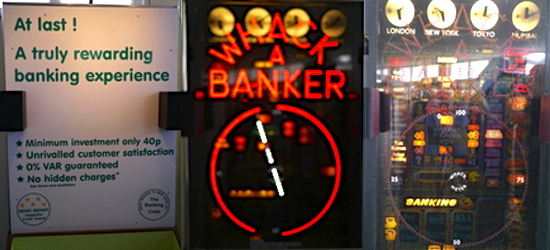
Whack a banker v2

I see the FT on Monday morning was announcing that Britain had been “outgunned” on EU bank curbs – a proposal from the European Parliament to limit bankers’ bonuses to twice base salaries looked likely to go through. However, a visit to Southwold Pier on the east coast of England at the weekend showed an alternative approach to the banking crisis – one that so far seems to have escaped the notice of the Basel Committee, the EU, the Obama administration, and the Financial Stability Board.

The picture gives a clue – it’s simply a “whack the banker” pier game, where, putting your 40p in the slot, you get the pleasure of whacking bankers for 60 seconds, with an accompanying audio commentary about your role as a taxpayer in funding their pensions and bonuses.

Of course, this may be dangerous territory for Southwold, as one suspects that some of the mouth-watering property prices in the vicinity may owe just a tad to – yes, you’ve guessed it, bank bonuses!