Archive | Uncategorized RSS feed for this section

50p tax rate? – perhaps the Bundesbank has a better idea

29 Jan

IFS analysis of 50p tax rate

Labour’s pledge to reintroduce the 50p tax rate for those on incomes of over £150,000 a year has met with a hostile business press. Mind you, as it is mainly the captains of industry, investment bankers and senior partners in legal and accounting firms who will be paying it, that’s not perhaps surprising.

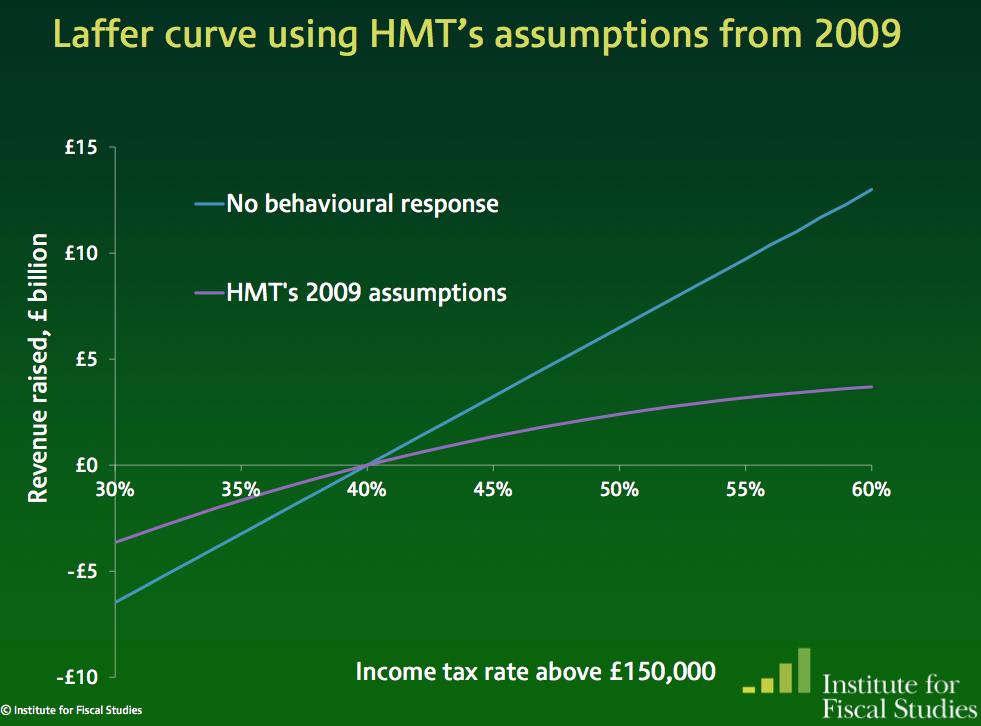
What has surprised me, as I have read into some of the background policy analysis, is how difficult it is to estimate the impact on the deficit. What HMRC calls the “static costing” is straightforward enough – reducing the rate, in 2012 from 50p to 45p was estimated to cost £3bn or so. But the net effect depends on how successful top rate taxpayers would be in shifting income otherwise liable to the 50p rate elsewhere – to another year, to another country, or to a form of income taxed less highly – say dividends or (even better) capital gains. HMRC ‘s exhaustive (and exhausting) analysis reckoned this would reduce the net cost from £3bn to roughly £100m in a full year – a staggering level of behavioural response (see diagram above, from IFS). Indeed, hidden in the small print of the HMRC analysis is the giveaway sentence:

“the estimated revenue-maximising rate of tax for those with incomes over £150,000 is between 45 per cent and 50 per cent” 

– in other words, at some point between a 45p tax rate and a 50p rate, an increase will actually reduce the tax tax. So, if you are going to “tax the rich till the pips squeak”, you had better stop somewhere between 45 and 50p.

Now in many countries the response would be “well, that’s what the Tories have paid HMRC to say”. But having waded through the document, I can confirm that, in this instance at least, the Northcote/Trevelyan reforms are holding good and it seems a pukka piece of analysis.

Labour’s problem is that there are just too many distortions in the tax system and too many opportunities for wealthy individuals to legally avoid tax. Part of this is related to globalisation – but part is the differential rates of tax in the UK between taxes on employment income and taxes on being self-employed or on dividends from a small business. Plus what are still generous treatments of capital gains versus earned income – differences which Venture Capital Trust allowances and their like amplify.

It is interesting that, while the 50p debate has been going on in the UK, across in Germany the Bundesbank was suggesting a wealth tax/capital levy could be a helpful device for countries [think Italy] seeking to reduce their deficits (see http://goo.gl/9BlQeB for the FT summary). Labour might find it more worthwhile, if less electorally popular, to delve into the mechanics of why so much income can be shifted in the UK, the taxation of wealth, and how, in a globalised world, “the rich” can be encouraged to pay “their fair share”.

Seasons greetings and thanks

22 Dec

Scrooge

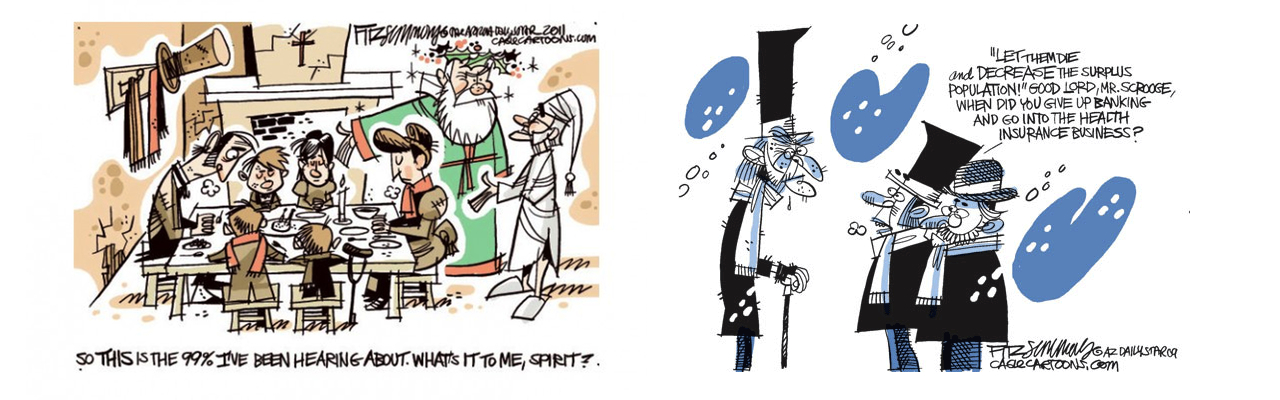
to my loyal band of followers – and trusting that you are all the later model, post-ghosts versions of Scrooge this Christmas! (NB – you may need to zoom in to read the captions.)

“Go & lobby in Washington” – Angus Deaton, author of The Great Escape

12 Dec

Just finished listening to Angus Deaton’s lecture at the LSE in October – see the link below. He was introducing his book about the “great escape” from poverty and ill health, and touching briefly on his controversial views on foreign aid (he doesn’t favour it). But listen to the end for his advice – as in the title – as to what his Princeton students should do about world poverty. The other great theme: don’t think in silos – people’s welfare involves politics and health as much as economics. Enjoy: http://goo.gl/IXHWrl

Some data for the globe-trotting social entrepreneur

11 Nov

Doing Business 2014

Ever wondered how long it would take you to start a new business in Suriname? 208 days apparently – at least, according to the World Bank report shown above. Worth a look – plus the blog commentary on it at goo.gl/id23Yl


Nuclear bonds are what we need

23 Oct

Nuclear

The deal on the financing of the new nuclear facilities at Hinkley Point has some interesting features. If EdF can manage the construction risk ( a big if, given the sagas at two other plants) they should earn a healthy (long term) rate of return, given the guaranteed, index-linked price offered for the electricity.

Unfortunately there are no obvious ways in which long term UK investors can take a punt on this. They could presumably buy the new bonds issued by China General Nuclear Power, priced at a mere 2.4% over treasuries, but they are only for five years and are dollar-denominated ( see http://goo.gl/DRPFnO).

The government could, of course, have structured the deal differently, and commissioned EdF to do the build while financing some of the costs by issuing its own sterling nuclear bonds – either on a conventional basis (as with China General) or as a kind of Social Impact Bond (see http://en.wikipedia.org/wiki/Social_impact_bond). The SIB could pay a coupon when the plant comes on stream, and link the coupon to the guaranteed electricity price.  If the place suffers a Fukushima-style disaster both capital & coupon on the SIB would be lost.

So far SIBs have been limited to non-energy programmes, but given the scale of the investment required there must be a case for looking at them here. For pension funds, they could be attractive, as they are a deferred, index linked asset to match their deferred, index-linked liability. And given the carbon benefits, even Prince Charles might be happy (last week, he was lecturing pension fund managers on the need for longer term, sustainable investments – hence the picture above). Come to think of it, perhaps he’s got room for some nuclear at Highgrove??.

The Thatcher government was bold enough to start index-linked bonds. It’s time for the coalition to step up to the mark and allow investors and taxpayers some upside on nuclear energy investment.

Prince Charles and sustainability

22 Oct

Prince Charles’ address to the National Association of Pension Funds  (see http://youtu.be/SXRwPzj6vxk) is worth a look – yes, it surprised me too, but he actually has some quite insightful things to say about long term sustainability.

Nobel Prize time in Economics – Fama & Schiller are consistent enough

15 Oct

Some complaints in the press (and among the academics, who should know better) about both Eugene Fama and Robert Schiller (plus the third man, Lars Peter Hansen) jointly winning the Nobel Prize for Economics.

Personally, I think it’s a great example – a theory (the efficient markets hypothesis) is developed, and leads to practical implementation in areas such as the development of indexed funds. Then another academic comes along (Schiller) pointing out the limitations of the theory. All three place a heavy emphasis on empirical validation – Fama from publishing his data, Schiller from creating the Case-Schiller House Price index for the US, and Hansen (OK, I hadn’t heard of him either) for valuable work in econometrics (see http://goo.gl/5PDxYW). Isn’t that what Kuhn’s theory of scientific revolutions is supposed to be all about?


Two hands not one: the role of the state

9 Oct

A quick addendum to my blog below on Africa post 2015  – catching up on my LSE Alumni collections, I see that Mariana Mazzucato was speaking recently on the role of the state – advocating a role beyond market fixing to market creation. You can get a quick 17 minute overview (if, like me, you missed the lecture itself) on Youtube – here’s a Tweet link:

plus you can also follow the good lady on Twitter itself.

Post 2015 Africa: central planning or the market?

3 Oct

Diageo Ethiopia

Attended an excellent event last week at Standard Chartered in the City, sponsored by Business Fights Poverty (http://businessfightspoverty.org). It was a panel discussion on a new report – “A New Global Partnership with Business – Building a post-2015 development framework to achieve sustainable prosperity in Africa”. Despite the mouthful of a title (and the title slide for the presentation had no less than eight corporate sponsors – four at the top, four at the bottom), the report is actually a good read (download from here: http://goo.gl/SG8FOT).

The panel discussion was equally good. By the time it had finished, I was feeling quite sorry for Diageo, very ably represented by Ann McCormick. They are one of the case studies in the report, focusing on their acquisition of Meta Abo Brewery in Ethiopia and their efforts to source more malt & barley locally. Their partnership efforts were certainly impressive, spanning the top (a G8 pledge signed with Obama & Hilary Clinton watching), the Ethiopian government (via their Agricultural Transformation Agency) and local implementation via an NGO working with smallholder farmers (Farm Africa). But what struck me in discussion was Ann McCormick’s obvious concern as to what the newly enriched smallholders were actually doing with their extra cash.

Hardly a problem, one would think, when Diageo buys grain in the developed world, but probably a real enough issue in Ethiopia. And just one small example of the hurdles businesses have to jump through to be good corporate citizens in Africa.

So why the title? I recall a lecturer in Cambridge saying once: “When I visit Russia [this was the 1970s] I think – My God, how they would benefit from some market mechanisms. Then when I visit the States, I think: My God, a bit of central planning wouldn’t hurt.” At the time, I was too inexperienced to value the remark, but with the passage of time I see its truth. The market can’t solve everything in Africa (or elsewhere) – it needs other institutions, including government, to play their part. One invisible hand is all very well, but two hands are better.

Time for a change – more focus on social entrepreneurship

24 Sep

The observant among you will have noticed that I’ve changed the strapline on this blog to reflect my current interests – namely “social entrepreneurship” (of which more below), financial services, and public policy.

It’s an eclectic mix – but its foundation is my training as an economist, and how I’ve spent my time since graduating in 1975 – firstly, 10 years as an economist in government (including 5 years at H M Treasury in the early 1980s), and then 25 odd years in management consulting, focusing first on public policy questions and then for the last 15 years on financial services.

Social entrepreneurship is new. Over the last year or so since leaving IBM I have become increasingly interested in the role business (including small business) can play in helping to solve social problems, both in the UK and overseas, and have started to network more widely (my first meeting with Business Fights Poverty –  http://businessfightspoverty.org – is tomorrow). To my mind, this is an idea whose time has come – I was delighted to see that Esther Duflo (co-author with Abhijit Banerjee of Poor Economics) was this year’s Marshall Lecturer at Cambridge, and Georgia Keohane’s book and lecture, at the LSE, on Social Entrepreneurship for the 21st Century was also inspiring. Like Keynes, I think it is ideas, not vested interests, which are dangerous for good or evil – in this case, very much for good.

There are of course important links between these themes. Social entrepreneurship, as Keohane shows, is highly dependent on the public policy framework, and finance and investment play a major role in economic development. Of course, sometimes it is tempting just to abandon an avenue – looking at the latest financial mis-selling scandals, you feel the industry is like the Bourbons “they have learnt nothing and forgotten nothing”.  But I still find things I want to say.

So I hope you will like this eclectic mix – and I would welcome your feedback!

← Back

Thank you for your response. ✨