Interesting week on “not [just] for profit” front

21 Jun

Social entrepreneurship

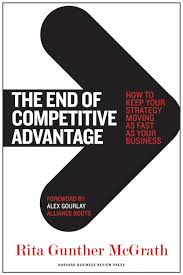
So an excuse this week to visit both alma maters – LSE Alumni on Monday evening to hear Georgia Keohane speak about her book (shown above – US-centric but highly recommended) and then, yesterday, a very English event at the Humanitarian Centre, in Cambridge  – strawberries & cream & Sangria with Fenners in the background, on a “rained out” English summer afternoon (my wife, being German, doesn’t believe there is any other kind).

No real content to report from Fenners. But several interesting discussions at the LSE, where Georgia picked out the role of social impact bonds, and their complex interaction with public sector safety nets (i.e. you need public expenditure savings from delivering cheaper public services to fund the bond coupon). Chasing around Twitter/YouTube afterwards, there was also a great clip on what levels of financial returns should be expected from BoP/social impact investing. General view seemed to be at least a “normal” return, but potentially over a longer timescale.

Interesting to think social entrepreneurship could both be more socially useful and more financially rewarding than hedge funds.

The answer to savers’ prayers?

4 Jun

Screenshot_04_06_2013_15_28

So a couple of articles caught my eye in Friday’s FT (31st May – I know this post is a bit late but the weather really has been good!). The first was a prequel to the Banking Commission’s final report – due in June apparently (let’s hope it doesn’t clash with Wimbledon).  This whinged on about the need for a more diverse banking ecosystem (“Rivals sought for Big Five banks” – of course, it would have been the Big Four a few years ago, so perhaps the arrival of Santander means a 20% increase in competition??).

The second article contained the potential solution – it featured the arrival of the new head of PopeBank – or, for the more traditionally minded, the Institute for the Works of Religion (IOR), a Teutonic gentleman by the name of Herr von Freyberg (appointed by the outgoing pope, who helpfully gave him a rosary). No it has to be said that there are a few technical difficulties to be sorted out at PopeBank, but just think of the impact it could have on the UK High Street:

  • guaranteed ethical standards
  • free advertising at every mass
  • cash distribution system already there – just drop another envelope with your account number into the collection
  • plenty of premises for extra ATM machines
  • no need to “bail in” bondholders in the event of difficulties – just ask the faithful to stump up
  • ready-made cadre of financial advisers (viz priests – touch of extra training should do it)

One might even call it a solution made in heaven!

Bank 3.0 – if branches are so yesterday, why are they so full?

25 Apr

So I’m sitting in the sun actually reading Brett King’s Bank 3.0 (rather than just blogging it’s arrived). It’s a good read – I’m on Chapter 3 – Can the branch be saved?- which rather begs the question as to whether you would want to.

I find all the arguments about the need for banking but not for banks very persuasive, and Brett has sourced his evidence well. But perhaps the sunny day helps me to drift off, & I remember a day a couple of years ago when I was in a bank branch (RBS) on a Saturday morning in a market town near us (Chelmsford UK, pop. 100,000).

I was there because there was a cock-up on arranging “floats” for a plant sale I run once a year. There are ten or so stalls, and the turnover on the day is about £2k – about half in cheques and half in cash. There was a new treasurer for the event, and he hadn’t arranged any cash floats for the stallholders, and couldn’t be reached on the phone. So off I went to the nearest market town to see what I could do.

To save you the unbearable suspense, I can tell you that it worked fine. After a rather exasperated counter guy had asked why I hadn’t arranged it in advance, & I had grovelled appropriately, the bags of coins and crisp £5 notes were duly handed over for a wad of cash I had extracted from the ATM. RBS went up several points in my estimation (albeit from a very low base – but that’s a different story).

But the real thing that surprised me was how full the branch was on a sunny Saturday morning of a bank holiday weekend in early May. I knew why I was there – but they couldn’t all be running competing plant sales with similar float cock-ups – could they? It seemed unlikely. Nor were they elderly pensioners unable to cope with new technology – it looked like a pretty representative cross-section of Chelmsford humanity. And it included some digital natives – at least one guy was playing with his i-Phone while standing in the counter queue.

I suppose my experience (admittedly two years ago) may have been atypical, but in my infrequent visits to my own bank branches (HSBC), there still seem to be plenty of people milling about.

So is this irrational behaviour?  Given the stats, the majority of the people I see in branches will have smartphones and/or tablets plus internet access at home & work. However, I’m not sure this makes their behaviour irrational. Like me, they may be dealing with the grubbier end of money transmission – cheques and cash, which, while on the decline, ain’t dying anytime soon. Witness the UK Payments Council’s (wise) decision to back off from announcing the death of the cheque. Or perhaps they were passing & popped in to check something (as I did recently).

Or perhaps they were attracted by the “store makeover” of may retail branches? This is the bit I just don’t believe. Brett has a good section on bank execs trying to remake their stores a la Apple. But if the parallel to a new game on a shiny new retina display is a flexible mortgage or special 1% bonuses on savings (Gosh! – a whole £10 on my £1,000 savings!) I think we can forget it. The trouble with banking is that it’s just too boring.

Brett quotes Chris Skinner’s phrase with approval – less branch banking rather than branchless banking. And how much less will depend on finding cost-effective substitutes for cash and cheques – for SMEs as well as individuals. Or (horror of horrors) a better alignment of prices for money transmission with the true costs.

The other change required is in the mental models bankers use – so they embrace the use of other channels (telephone/Skype/internet/mobile) as a substitute for face to face advice. And, as Brett recommends, realign their budgets so they address the security issues around these channels rather than simply saying they can’t be used.

Salz Review of Barclays – and you thought management consultancy was expensive?

5 Apr

Salz review

There has been some excellent press commentary on this since it was published yesterday. The FT, in particular, has excelled itself – Jonathan Guthrie in Lombard had a spoof sermon from Rev Salz – the visiting preacher at St Barcalys Beyond the Pale ( see http://goo.gl/OBlHF) and Lex has an excellent video (Q from Stuart Kirk, Head of Lex – “Is it simply a statement of the “bleedin’ obvious” – A from Oliver Ralf of Lex – “Yes”; see http://goo.gl/hKJSn for more).

So I will confine myself to two points. One is cost – where the first figure I saw reported was £14.5m, which then rose mysteriously to £17m – presumably the VAT-inclusive price. Now as Anthony Salz’ firm (Rothschild) was “only” paid £1.5m in lieu of his services, that leaves a whole £13m unaccounted for. Comparable consultancy fees from a strategy boutique? Running the slide rule over it, I reckon about £2m should do it. So if I were a shareholder I would be asking some questions – a good starting point might be to get the non-execs over the period covered by Salz to pay for it, since he is basically commenting on their weaknesses.

The second point is not unique to Barclays, and is about changing the rules of the game. As you read through the report, you realise that, over the period from 2005 to 2012, the rules of the game changed – it was as if, coming out after half time, Barclays was faced with an Alice in Wonderland world where the goalposts were smaller and someone had abolished the offside rule. HMRC’s attitude to tax was a good example (see chapter 6). Barclays failed to adapt in time. Businesses need monitoring systems which tell them not only what their competitors are up to but also when the mindset of key stakeholders such as regulators undergo a sea change.

An Easter present for everyone who likes change management

1 Apr

A great set of cartoons for all the actors in the change management drama – plus some useful videos which you can use in your own presentations. And (so far) for free. Enjoy! – here is the weblink  – http://goo.gl/XDWYAChange cartoons

So what is the effect of the Budget on growth? – nil, according to the OBR

20 Mar

Yup, that’s right – nil. Here is the key sentence from the OBR : “The ‘giveaways’ and ‘takeaways’ net to zero when aggregated over the forecast. We have made no significant adjustments to our economic forecast to reflect these measures.” [italics are mine] See para 1.7 of the OBR’s Economic and Fiscal Outlook –  at http://goo.gl/C23eR

Real returns and market timing

20 Feb

No rest wicked“No rest for the wicked”, as my (Catholic) grandfather used to say – or as the latest evidence from the famous LBS stable of Elroy Dimson, Paul Marsh & Mike Staunton shows, no rest for those trying to earn a “decent” (5% real?) return from their savings. They foresee a world of virtually zero real rates on “safe” bonds and an equity risk premium of 3 to 3.5% on a “long” (20-30 year) view. This is all set out with impressive academic rigour in the excellent (and free, as far as I can see) Credit Suisse Global Investment Returns Yearbook for 2013 (http://goo.gl/CHmU7).
They also pretty effectively dish “market timing” strategies in favour of buy and hold – for those of you with access to the FT, there is an excellent video of an interview with Elroy by John Authers which is also a must see.

The only saving grace I can see in this is that we should, on this basis, expect a boom in capital investment, especially in long-lived capital investment projects, which should now require lower real returns. So now should be the time for new water ring mains, Crossrail Mark 2, third London Airport et al. The trouble is, I cannot see our crotchety Coalition government and rather antique planning laws delivering on this in the foreseeable future.

Banking reform – Southwold shows the way!

19 Feb

Whack a banker v2

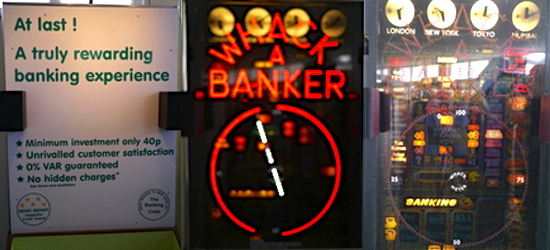
I see the FT on Monday morning was announcing that Britain had been “outgunned” on EU bank curbs – a proposal from the European Parliament to limit bankers’ bonuses to twice base salaries looked likely to go through. However, a visit to Southwold Pier on the east coast of England at the weekend showed an alternative approach to the banking crisis – one that so far seems to have escaped the notice of the Basel Committee, the EU, the Obama administration, and the Financial Stability Board.

The picture gives a clue – it’s simply a “whack the banker” pier game, where, putting your 40p in the slot, you get the pleasure of whacking bankers for 60 seconds, with an accompanying audio commentary about your role as a taxpayer in funding their pensions and bonuses.

Of course, this may be dangerous territory for Southwold, as one suspects that some of the mouth-watering property prices in the vicinity may owe just a tad to – yes, you’ve guessed it, bank bonuses!

Obama & Stiglitz on inequality and the power of the state

11 Feb

I first saw clips of Obama’s second inaugural speech (see http://goo.gl/S62Wi) on newsroom reports – and was so encouraged by the clips that I thought I should listen to the whole twenty minutes. It doesn’t disappoint.

In parallel with this I’ve been reading Stiglitz’ book on Inequality. He documents clearly the rising levels of inequality in income & wealth in the US since the Reagan years. While not all of this increase has been driven by policy (globalisation has played a major part), there is no doubt that the favourable treatment of non-labour income is a a major culprit.

How do these inequalities stand up against the Declaration of Independence’ “self evident” truth that all men are created equal?  Obama is clear: “..while these truths may be self-evident, they have never been self-executing; .. the patriots of 1776 did not fight to replace the tyranny of a king with the privileges of a few or the rule of a mob. They gave to us a Republic, a government of, and by, and for the people, entrusting each generation to keep safe our founding creed.”

He goes on “ But we have always understood that when times change, so must we; that fidelity to our founding principles requires new responses to new challenges; that preserving our individual freedoms ultimately requires collective action.”

The collective action he envisages turns on using the power of the state to provide (cost effective) safety nets, education and opportunity – “we must harness new ideas and technology to remake our government, revamp our tax code, reform our schools, and empower our citizens with the skills they need to work harder, learn more, and reach higher”.

And it isn’t all “socialism” – there are references to initiative and enterprise, hard work and personal responsibility, and America’s prosperity “resting upon the broad shoulders of a rising middle class”.

Stiglitz may have done the analysis – but it will take all of Obama’s campaigning skills to do something about it.

So if the stock market Santa is late, does the efficient markets hypothesis still apply?

21 Jan

Santa Efficient Markets

So there I was, working away in H M Treasury in the last Great Recession (1980-84 from memory), when one of my colleagues piped up – “so I suppose evidence of seasonality in stock market prices would be prima facie evidence against them being efficient?”

It was a rhetorical question, as the answer was obviously yes – if stock prices exhibited seasonality, say rising in the spring and falling in winter, you could trade to beat the market. So markets were not, in some sense, “efficient” – they did not price in all of the available information (in this case, the seasons). And if you had information they did not appear to have (in this case, whether it was spring or winter) you could do what Margaret Thatcher advised you could never do – buck the market.

“Oh come on”, I can hear you say, “can’t you find a better and less trivial example?” Well, how about this? As David Schwartz pointed out in an FT article on 30th November, in 19 of the previous 21 years since 1989, the stock market had risen in December. 2012 proved no exception, with a rise in the FT 100 (and FT All Share) – but by only 0.5%. However, the end of December was mired by worries about the US fiscal cliff, so had you hung on till the markets opened on the second of January, you would have done much better – a gain of over 2.5%. Hence the argument about Santa being delayed.

Evidence that perhaps markets are not as efficient as all that also comes from a more academic source, where Pontiff & McLean have published a paper on whether published academic research destroys stock return predictability – a paper also picked up by the FT. “Not completely” appears to be the short answer, although publication of a “profitable” trading strategy (ie buy before December) does then reduce the returns you can expect significantly – especially for large, easy to trade stocks.

Bit of a mystery, though, we still see the Santa effect in stock markets – after all, it must now count as a published strategy. Transactions costs? End of year trading constraints? Or are the arbitrageurs too busy at their Christmas parties?