Confessions of a forecaster

7 Sep

An interesting piece in this weekend’s FT magazine on forecasting by the undercover economist (and FT contributor) Tim Harford (see http://goo.gl/wazg8F if you have an FT subscription; it’s in the magazine in hard copy).

My interest comes from the odd desire I had when in my twenties to do econometrics, which led, given I was an economist in government at the time, to spending five years in HM Treasury as a macro economist and member of their forecasting team.
It was an interesting time to be there (from 1980 to 1985) as it was just after the arrival of the first Thatcher government. And I arrived as GDP was falling through the floor – 1979-83 was the worst post war recession until the 2008 crisis, with a peak to trough drop in GDP of 6%.
So did the forecasters foresee this? Not really, although there was a significant “change of view” at some point in 1980 when realisation dawned that it was going to be pretty awful. And the forecasters stuck to their guns in saying that any recovery would be slow – and were quite right in doing so.
The worst of the forecasting exercises was the “Medium Term Assessment” (MTA), which in practice was simply a Panglossian exercise in saying that we would get back to trend growth in the medium term. Adequate commentary on this was given by my undersecretary saying at some point in 1981 (the depths of the recession) “but when we did the MTA in 1975, this was the year it was all going to come right”.

So what do my ramblings have to do with Tim Harford’s piece? Well, it focuses on the work of the Good Judgement Project (https://www.goodjudgmentproject.com) which has uncovered some interesting insights into why forecasting does or does not work and how it can be improved. Key to it is that many forecasters are not, surprisingly enough, interested in being accurate – they are instead more focused in advancing a political cause (shades of the MTA again). If you want to be a good forecaster, forget that (an obvious source of bias). Instead, the Good Judgement Project recommends teamwork, keeping score (so error correction) and open – mindedness.

So on this basis setting up the (newish) Office of Budget Responsibility was a good move, and its forecasts should be better than the old, politically influenced, HMT ones. Well, there’s a Popperian falsifiable proposition for you!

The non-entrpreneurial state: HBR on China

3 May

I’ve blogged before on the role of the state in economic development  – see my posts of 3rd and 9th of October last year. Specifically, I’ve referred to Mariano Mazzucato’s book on The Entrepreneurial State. It has some good stuff, but I’ve always had this nagging doubt that the case studies it uses are too US-centric – too US military spend-centric in particular. It certainly doesn’t seem to work so well in the UK – across the pond, they get (and the world gets) the iPhone; we get Concorde and British Leyland.

My unease is beefed up by an article in the March HBR (“Why China can’t innovate” – see http://hbr.org/2014/03/why-china-cant-innovate/ar/1). The authors point out that the role of the state in enterprises (“scour the company’s board for the real boss”) is a real brake on innovation. Their last sentence is worth quoting in full: “The problem, we think, is not the innovative or intellectual capacity of the Chinese people, which is boundless, but the political world, in which their schools, universities, and businesses need to operate, which is very much bounded”.

I hear that Mariano Mazzucato is adviser here to both government and opposition. I hope, as they look at her ideas, they consider why The Entrepreneurial State works better in some institutional contexts than in others.


Lokichoggio in the modern economy?

4 Apr

Loki from the airLoki mapBreugel field Denver city

So we are just back from a week in Lokichoggio, Northern Kenya – one of Kenya’s semi-arid areas. It’s part of Turkana County, which on most measures is one of the poorest areas in Kenya, and is basically a border town between Kenya and South Sudan – with its own airstrip, and an interesting collection of planes that didn’t quite make it.

There is lots to blog about (watch this space) but here is my first and abiding impression. We are running a seminar for some of the local community leaders on the Saturday. We put up the two pictures – the Breugel image of Europe in the 1500s and the modern US city at night, and ask everybody to tell us the differences. They are pretty sharp – Europe 500 years ago has no tall buildings, no roads, lots of manual work, people working outside, and a lack of market access. They see the modern economy as about railways, urbanisation, cities, power and electricity, good roads, working inside, lots of cars and transport links – nowhere is remote.

Then comes the interesting bit: is Lokichoggio part of the “old”economy or part of the modern economy? People are not sure – and after some discussion vote for it to be “in the middle”

“Stuck in the middle” is a good summary of many areas like Lokichoggio. The modern economy is going on all around them, but they are not quite part of it. The roads are crap – the A1, apparently about to be improved, is the main arterial road from Nairobi to South Sudan, but at present is full of potholes and liable to flooding. Power is a bit hit and miss – there was much rejoicing when we arrived that the dispute about payment for the new substation had been resolved, so power was back on again (it had been off for several weeks). Minimal education means a lack of training in basic skills like welding and plumbing. Meanwhile, wifi access was really rather good……

Of course, diagnosis is easier than cure – but Tony Blair’s old cry of “education, education, education” has got to be part of the answer.

SMEs role in development – CAFOD has useful stuff to say

27 Feb

Screen Shot 2014-02-27 at 16.15.35

Good report from CAFOD on this subject – see http://goo.gl/Xb9Gpd . At least, the exec summary looks good and in line with World Bank “Doing Business” indicators. And check out the Business Fights Poverty website where they have been running an online discussion on the role of small-scale, local development.

50p tax rate? – perhaps the Bundesbank has a better idea

29 Jan

IFS analysis of 50p tax rate

Labour’s pledge to reintroduce the 50p tax rate for those on incomes of over £150,000 a year has met with a hostile business press. Mind you, as it is mainly the captains of industry, investment bankers and senior partners in legal and accounting firms who will be paying it, that’s not perhaps surprising.

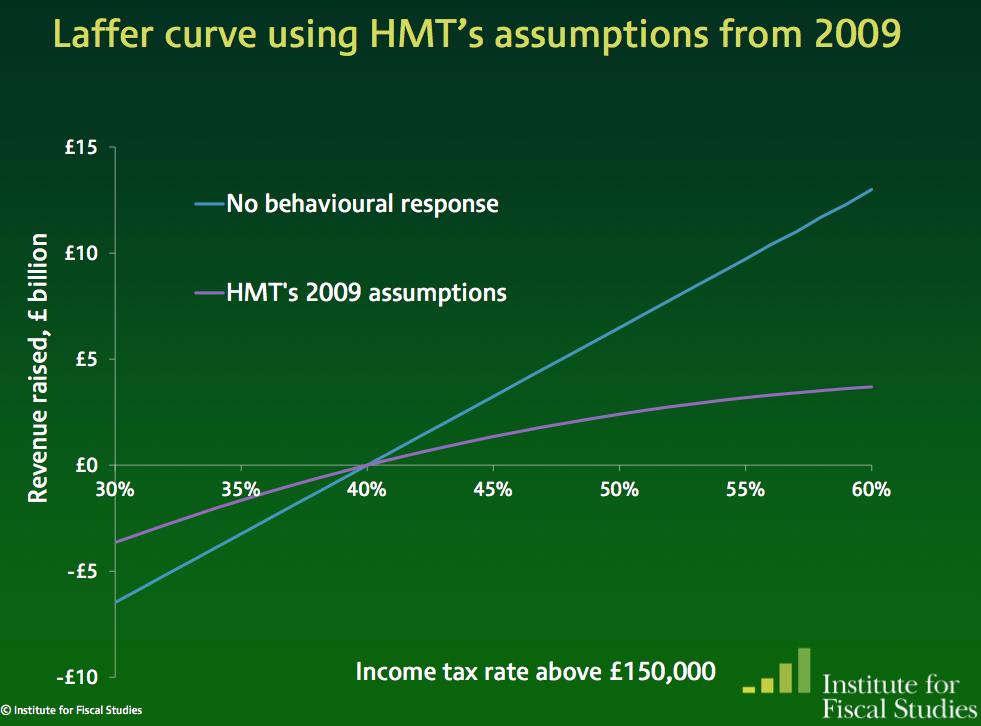
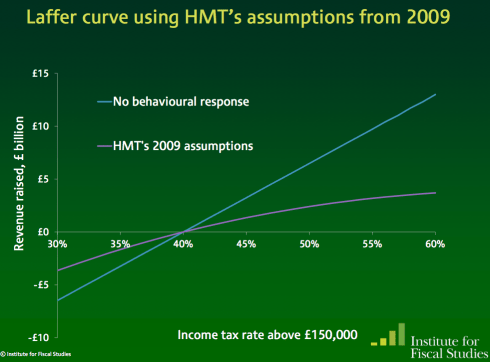
What has surprised me, as I have read into some of the background policy analysis, is how difficult it is to estimate the impact on the deficit. What HMRC calls the “static costing” is straightforward enough – reducing the rate, in 2012 from 50p to 45p was estimated to cost £3bn or so. But the net effect depends on how successful top rate taxpayers would be in shifting income otherwise liable to the 50p rate elsewhere – to another year, to another country, or to a form of income taxed less highly – say dividends or (even better) capital gains. HMRC ‘s exhaustive (and exhausting) analysis reckoned this would reduce the net cost from £3bn to roughly £100m in a full year – a staggering level of behavioural response (see diagram above, from IFS). Indeed, hidden in the small print of the HMRC analysis is the giveaway sentence:

“the estimated revenue-maximising rate of tax for those with incomes over £150,000 is between 45 per cent and 50 per cent” 

– in other words, at some point between a 45p tax rate and a 50p rate, an increase will actually reduce the tax tax. So, if you are going to “tax the rich till the pips squeak”, you had better stop somewhere between 45 and 50p.

Now in many countries the response would be “well, that’s what the Tories have paid HMRC to say”. But having waded through the document, I can confirm that, in this instance at least, the Northcote/Trevelyan reforms are holding good and it seems a pukka piece of analysis.

Labour’s problem is that there are just too many distortions in the tax system and too many opportunities for wealthy individuals to legally avoid tax. Part of this is related to globalisation – but part is the differential rates of tax in the UK between taxes on employment income and taxes on being self-employed or on dividends from a small business. Plus what are still generous treatments of capital gains versus earned income – differences which Venture Capital Trust allowances and their like amplify.

It is interesting that, while the 50p debate has been going on in the UK, across in Germany the Bundesbank was suggesting a wealth tax/capital levy could be a helpful device for countries [think Italy] seeking to reduce their deficits (see http://goo.gl/9BlQeB for the FT summary). Labour might find it more worthwhile, if less electorally popular, to delve into the mechanics of why so much income can be shifted in the UK, the taxation of wealth, and how, in a globalised world, “the rich” can be encouraged to pay “their fair share”.

Sen on Poverty – the tolerance of the intolerable

23 Jan

Amartya Sen


Amartya Sen was lecturing last night at the LSE on this topic – sold out, as you might expect (2,000 enquiries in the first hour, apparently). But you could also watch a live webcast which worked well – check the LSE video site – http://goo.gl/Kqs6w7 – for the replay

He looked at possible reasons for why we tolerate poverty – ignorance, a belief it is impossible to remove it, and self-centredness (“no obligation”) and found all of them lacking. Of most interest to me were his illustrations from India, and the contrasts between India and China.

I had three key takeaways. First, on ignorance: Sen described how the Indian media ignored extreme poverty because they were “controlled” by the middle classes, in the sense that they pandered to the interests and obsessions of the middle class to ensure their advertising income. Hence little reporting of extreme poverty in India. So my thoughts turned to William Wilberforce, the crusader against the slave trade. I realised, perhaps for the first time, that part of his greatness was to rub the noses of the society of his day into what slavery really meant so that the elite that made the laws could not simply ignore it. I suppose the modern equivalent is “Benefit Street” and forcing politicians to live rough for a bit.

Second, the need for “balanced growth” – not in the sense necessarily of balance between sectors, but in the sense of balance between public and private provision. You need to grow healthcare and education as much as business if your economy is to thrive. A malnourished workforce is not that productive.

Third – think quantitatively about poverty and policy. In the Q&A session, Sen dealt with an argument that “India’s greatest problem was employment subsidies” – and simply showed that this was unlikely given their small cost, and that the much greater cost of utility subsidies to the middle classes were much larger. Avoid dogma and stick to facts and reason was a good message to put across.


Seasons greetings and thanks

22 Dec

Scrooge

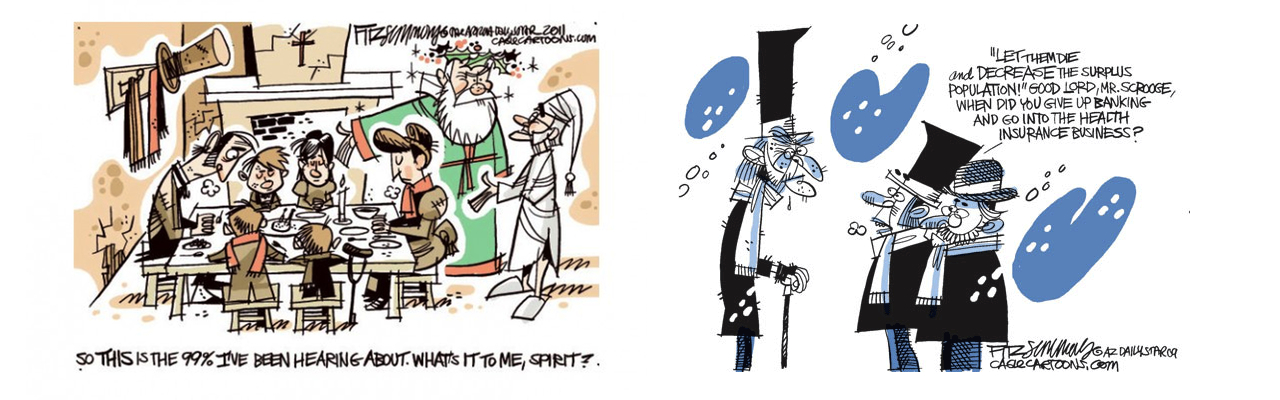
to my loyal band of followers – and trusting that you are all the later model, post-ghosts versions of Scrooge this Christmas! (NB – you may need to zoom in to read the captions.)

“Go & lobby in Washington” – Angus Deaton, author of The Great Escape

12 Dec

Just finished listening to Angus Deaton’s lecture at the LSE in October – see the link below. He was introducing his book about the “great escape” from poverty and ill health, and touching briefly on his controversial views on foreign aid (he doesn’t favour it). But listen to the end for his advice – as in the title – as to what his Princeton students should do about world poverty. The other great theme: don’t think in silos – people’s welfare involves politics and health as much as economics. Enjoy: http://goo.gl/IXHWrl

Whizzo! – tax relief is coming for social impact investing

6 Dec

Desparate dan


I am indebted to the Financial Times, today’s edition, bottom of p5 , for alerting me to George Osborne’s plans for tax breaks for “social capital” – see p 87 of the Autumn Statement, which you can download here – http://goo.gl/vGQ3WU

This seems to mean equity or loan investments will qualify for relief at the investor’s marginal tax rate, as already happens for Venture Capital Trusts (see, for example, this from Citywire  – http://goo.gl/JcynaC). As we are promised a “road plan” for this in January, we should know more then. Here is the relevant paragraph in the AS:

2.51 Social investment tax relief – The government will introduce a new tax relief for equity and certain debt investments in social enterprises with effect from April 2014. Organisations which are charities, community interest companies or community benefit societies will be eligible. Following consultation, investment in social impact bonds issued by companies limited by shares will also be eligible. The government will publish a roadmap for social investment in January 2014. (Finance Bill 2014) .


HSBC (USA) vs Brett King – the five deadly sins

4 Dec

No doubt many of you will have read the hilarious story of Brett King & his tussle with HSBC USA over their closing his business banking account (see http://goo.gl/hpnHu7). Only hilarious, mind, if you are not Brett King, one of his employees, or a shareholder in HSBC.

It’s really a mind-boggling list of sins:

  • failure to check if business account holder had other accounts (he did, and one assumes profitable ones to HSBC)
  • using wrong (and expensive) communication method (snail mail – Brett uses internet banking)
  • failing to keep data up to date (Brett had moved – which presumably was on the public record apart from anything else)
  • giving wrong advice on channel use (go to a branch when branch is closed)
  • failing to monitor & respond to social media comments (if you are going to run a social media presence, you had better watch what your customers post on it)

Now – confession time. Several years ago, I actually moved my accounts to HSBC – from Barclays, as they were (at the time) even worse. And as a customer I would actually rate HSBC pretty highly – especially on internet banking, where their Global View facility works very well. But then, I’m not Brett King, who doubtless has other thoughts.

And who will no doubt be using this case to strengthen his argument for Movenbank (see https://movenbank.com).